Improving reliability shouldn’t be about reacting faster when something fails, it should be about reducing how often failures happen in the first place.
In most industrial environments, reliability is measured by how long equipment runs before failure. This is often tracked using Mean Time Between Failures (MTBF), which measures the average time between failures.
Improving MTBF means failures happen less frequently, equipment runs longer, and operations become more predictable.
The challenge is that many maintenance strategies are not designed to achieve this.
In many operations, maintenance is still driven by routine, meaning assets are serviced at fixed intervals based on OEM guidance or historical practice. While this CAN reduce the likelihood of failure, it does not account for how equipment is actually being used.
In an industrial setting, operating conditions vary, so load, environment and duty cycle all influence how quickly components degrade.
As a result, some assets are maintained too frequently, while others are not maintained enough, which means failures still occur, and improvements in MTBF are limited.
Without real condition data, reliability reaches a ceiling.
Improving MTBF requires a change in approach.
Reactive maintenance sits at one end of the scale – equipment is repaired only after it fails, leading to unplanned downtime and disruption.
Preventive maintenance improves on this by introducing scheduled interventions. While this reduces some risk, it still relies on assumptions about asset behaviour.
Predictive or condition-based maintenance moves beyond both.
Here, maintenance decisions are based on actual asset condition – instead of estimating when a machine might fail, teams can see how it is performing and act accordingly.
This shift is what enables sustained improvements in MTBF.
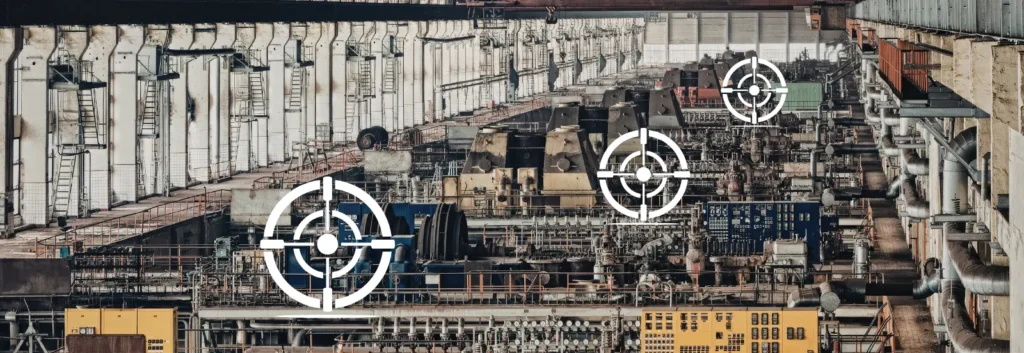
For large-scale industrial machinery environments, condition monitoring provides continuous visibility into asset performance across the whole factory.
By collecting vibration, temperature and operational data, it becomes possible to detect early signs of degradation at scale – changes often occur long before a failure becomes critical.
This is where MTBF begins to improve.
When faults are identified early, maintenance can be planned and controlled, so rather than reacting to breakdowns, teams intervene at the right time, preventing failures from occurring at all.
Over time, this reduces the frequency of failures and extends asset life.
It’s important to understand that collecting data alone does not improve reliability – the value comes from how that data is used.
As monitoring systems gather information over time, patterns begin to emerge, and teams can see how assets behave under normal conditions and how that behaviour changes as faults develop.
This allows maintenance teams to make decisions based on evidence rather than assumptions.
Interventions become more accurate, unnecessary work is reduced, and repeat failures are less likely, contributing directly to improving MTBF.
One of the most important benefits of condition monitoring is the feedback it creates.
When a maintenance action is taken, its impact can be measured and recorded. If a repair resolves the issue, this is reflected in the data and over time, this builds a clearer understanding of asset behaviour.
That insight means maintenance strategies can be refined, recurring issues can be addressed, and decisions about repair or replacement can be made with greater confidence.
It’s this cycle of data, action and review that drives long-term improvements in MTBF.
For industrial machinery, scalability is where wireless solutions like Dynamox sensors come into their own.
Rather than monitoring being limited to a small number of critical assets, wireless condition monitoring makes it possible to extend across a much wider range of equipment.
Sensors can be deployed quickly on motors, pumps, conveyors and gearboxes, providing continuous data without complex installation – at scale – and this allows improvements in MTBF to be achieved across the entire operation, rather than in isolated areas.
Condition monitoring’s impact builds over time as more data is collected and more decisions are informed by that data.
Failures become less frequent, maintenance becomes more targeted, asset life is extended and the whole process becomes a hollistic approach that improves MTBF in a meaningful and sustainable way.
If you are looking to improve reliability, the first step is understanding how your assets are performing today.
A condition monitoring trial provides a practical way to gather that insight, allowing you to see real data from your own equipment and identify where improvements can be made.
Get in touch to arrange a trial and talk about how it can work in your industrial setting.