
Poor lubrication remains one of the most common causes of failure in rotating equipment.
Bearings, gearboxes and motors all rely on correct lubrication to reduce friction, manage heat and prevent metal-to-metal contact. When lubrication degrades, becomes contaminated or is applied incorrectly, asset health can decline rapidly.
The challenge is that lubrication issues rarely announce themselves clearly. By the time temperatures rise or audible noise is noticed, damage is often already underway.
This is where vibration condition monitoring changes the approach.

Wireless vibration sensors such as Dynamox provide early visibility of lubrication problems, allowing maintenance teams to intervene before minor issues become major failures.
In practice, lubrication management is often inconsistent. We regularly encounter situations where:
Time-based routines may feel structured, but they rarely reflect how equipment is actually performing. Modern asset maintenance requires evidence and data, not assumptions.
Lubrication failures can result from:
Each of these increases friction and heat inside the bearing. Over time, this accelerates wear, reduces asset life and increases the likelihood of unplanned downtime.
Left unchecked, lubrication issues can lead to bearing seizure, shaft damage, costly shutdowns or secondary equipment failures.
Lubrication directly affects a machine’s vibration signature.
When lubrication is insufficient or degraded, increased surface friction and micro-impacts occur inside the bearing. This typically produces:
These changes often appear well before temperature alarms or audible indicators… The key is early detection.
Vibration monitoring is one of the most effective early-warning tools for lubrication management.
Dynamox wireless vibration sensors provide continuous condition monitoring across rotating assets and when applied to lubrication control, they offer several advantages.
Dynamox sensors capture high-resolution spectral data, enabling early identification of friction-related vibration increases associated with poor lubrication.
Rather than relying on periodic inspections, sensors continuously track vibration trends. Gradual increases can indicate lubricant degradation before mechanical damage develops.
By configuring Dynamox alarms based on the behaviour of healthy equipment, maintenance teams can be alerted automatically when intervention is required.
Poor lubrication can accelerate bearing wear or mask developing defects. Continuous monitoring helps distinguish between lubrication-related behaviour and early-stage bearing faults.
Because the sensors are wireless and battery-powered, they can be installed on pumps, fans, motors, conveyors and line shafts without complex wiring.
This makes it realistic to monitor lubrication performance across an entire facility.
In one recent project focused on condition-based lubrication of line shafts, a structured approach was developed using Dynamox vibration data.
In many cases, high-frequency activity in the 2 kHz to 6 kHz range begins to rise, creating what analysts often describe as carpet vibration within the spectrum.
The approach included:
As lubrication performance declined, high-frequency vibration activity gradually increased. Using the Dynamox waterfall function, the growth of this signature was clearly visible across successive spectra.
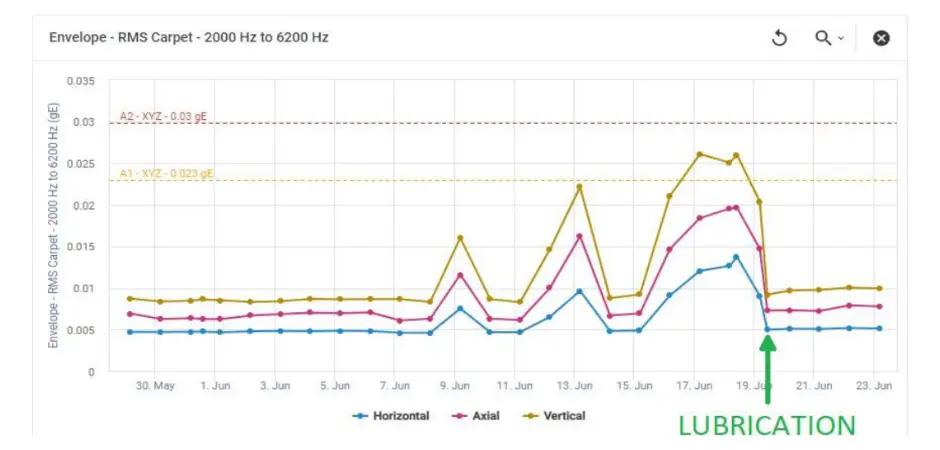
Once the correct lubrication was applied, the high-frequency activity reduced significantly within 24 hours.
This was not a one-off event. It demonstrated a repeatable, evidence-based lubrication strategy that improved machine longevity and process reliability.
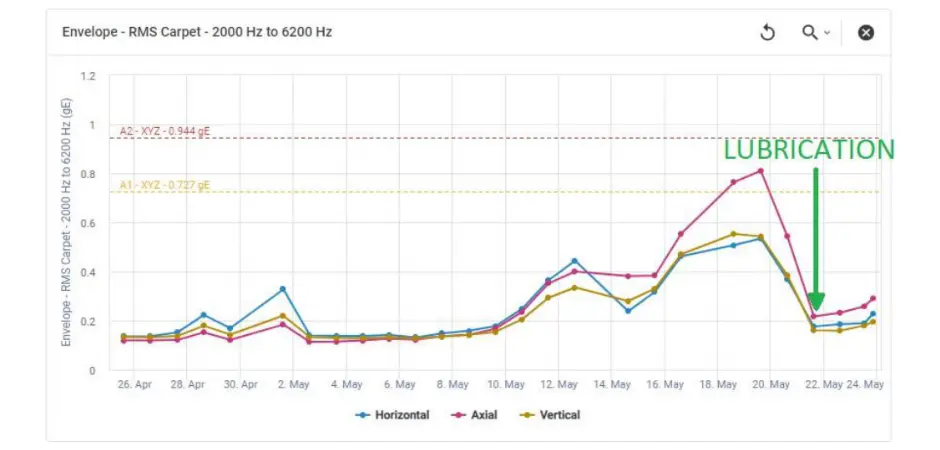
One of the biggest benefits of wireless condition monitoring is the ability to move away from rigid lubrication schedules.
Instead of greasing based on calendar intervals, teams can lubricate based on evidence, which allows maintenance teams to apply grease only when vibration trends indicate a need.
This approach means you avoid over-greasing, which can be just as damaging as under-lubrication and you reduce lubricant consumption and maintenance labour requirements.
Facilities that implement vibration-based lubrication monitoring commonly report extended bearing life, fewer unplanned shutdowns, lower maintenance costs and improved overall equipment reliability.
Condition monitoring and the resultant condition-based lubrication are more precise, more efficient and more sustainable.
With continuous monitoring of vibration, maintenance teams gain the visibility needed to protect assets, improve reliability and optimise lubrication practices using real operational data.
Want to know more? Contact us today or read more about our trial kits.